The first time I got on a scooter in Bali, I was a passenger. Grab drivers, friends, random people, I had moments when I prayed for my life.
The first time I rode one alone was in Candidasa — a small town on Bali's east coast, not the Canggu or Ubud I'd been staying in. In those places I used Grab: cheap, easy, no stress. Then I moved to Candidasa and discovered Grab doesn't reach there. No taxis, no real alternatives. You want to go anywhere, you ride.
The night before, I watched YouTube videos on how to drive a scooter. In the morning I went to the rental. An old woman walked me through the controls and the basic techniques and sent me off. It worked — mostly. On flat roads I was fine. The moment things got steep or the road dropped sharply, I would slow right down, look at it, and sometimes just turn around. In Nusa Penida I didn't try at all. The roads there are too sharp and the drops too serious for someone still figuring out braking.
Chiang Mai, Pai, parts of Laos were different and beautiful. I needed a scooter there too — you can't reach most of the city without one — but this time something actually clicked.
I asked about renting one at my guesthouse. The owner quoted me 200 baht a day (about €5) and I said yes before I could think too hard about it. That's the only way to do anything scary. Don't think. Say yes. Figure out the rest after.
The bike was a sweet Scoopy Automatic — no clutch. That's important. If you're thinking about renting a scooter in Southeast Asia and you haven't ridden one before, start with an automatic. The learning curve is the traffic, not the gear changes.
What nobody warned me about: the traffic moves like water
Thai traffic doesn't follow rigid lane rules the way European traffic does. It finds gaps. Motorbikes pass on both sides. Tuk-tuks cut corners. Pedestrians step into the road with the calm of people who have made peace with probability.
The first 20 minutes I was terrified. I rode slowly, sweated through my shirt, stalled twice at junctions because I was braking too hard, and seriously considered turning around and giving the bike back.
Then something shifted. I stopped fighting the traffic and started moving with it. Slower where it was slow, finding gaps when they opened, not trying to predict everything. And the city opened up in a completely different way. Suddenly I could turn down any street, stop wherever I wanted, leave whenever I wanted. No waiting for tuk-tuks. No fixed routes. Total freedom of movement in a city I'd been in for three days and only half-seen.
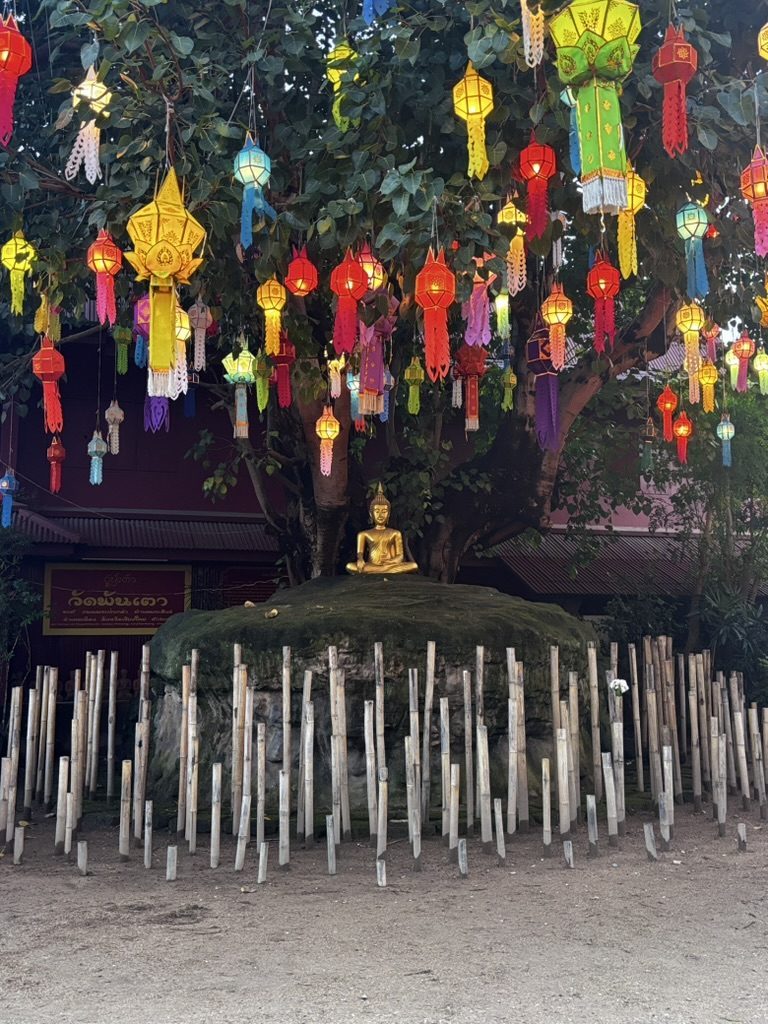
I rode for about five hours that day. Found three temples, including the one with the lantern tree that I've written about separately. Ate lunch at a place that had one table and a woman who made one dish. Discovered that Chiang Mai beyond the old city walls is a quieter, completely different place that most tourists never see because they can't reach it easily on foot or by the routes songthaews take.
What I wish someone had told me beforehand
- Always wear a helmet. Even the cheap rental ones are better than nothing. In Thailand this is also a legal requirement.
- An international driving permit is technically required. In practice, ask your guesthouse what the actual situation is locally — the answer varies by city and changes over time.
- Cover your arms. Sunburn on a scooter is real and it's worse than regular sunburn because you don't notice it until it's already bad.
- A face mask in city traffic is useful, not paranoid. Air quality in Chiang Mai in dry season is genuinely poor.
- Go slow. The accidents happen when tourists try to keep up with local traffic pace before they're ready.
- Don't ride at night until you know the roads. Street lighting is variable and the rules become even more fluid after dark.
- Check the bike before you take it. Photograph any existing scratches or damage so you're not paying for something that was already there.
The thing it actually changed
I've rented scooters in cities across Vietnam and Laos since Chiang Mai/ Bali. It's the single thing that changed how I travel most. The difference between seeing a place through the windows of a tuk-tuk and moving through it at your own pace on a bike is the difference between watching a film and being in it.
There's also something specifically useful about it for solo female travel. You're not dependent on drivers. You're not negotiating fares. You're not waiting for anyone. You go where you want, when you want, and you leave when you're ready. The freedom that most people associate with solo travel — the version that actually delivers on the promise — gets about ten times more real when you're on two wheels.
Is it slightly scary at first? Yes — I turned around on more than one steep road in Bali, and Nusa Penida I skipped entirely. That's fine. You figure out where your edge is and then you push it a little further each time. I'm at the point now where I'm thinking about getting a motorcycle.
Not every trip is a scooter ride. Book the rest on 12Go.
For the journeys too long for a scooter — between cities, islands or countries — I used 12Go to book buses, trains and ferries across Thailand, Vietnam, Bali and Laos. Compare options and book ahead, all in one place.
Compare Routes on 12GoThis is an affiliate link — if you book through it, I may earn a small commission at no extra cost to you.