The idea is simple enough that it sounds like something a reasonable person would not do: on or around your birthday, you cover as many kilometres as you are years old. Run them, hike them, bike them — the movement is yours to choose. The number is not.
I turned 29. I chose the Retezat.
I should give some context. I'd left home — Craiova, a smaller city in southern Romania — at 27, which is late by some standards. Moving to Cluj-Napoca changed things for me. It was in Cluj that I discovered I was actually an outdoors person: cycling, hiking, running in the mountains, anything that got me away from a screen and into something physical. It took me a while to find that out about myself. Once I did, I made up for lost time.
A bit before my birthday I'd met two guys who were real athletes — we'd teamed up for a week of hiking in the Dolomites together, which is its own story. But we stayed friends after that. When my birthday came around, they wanted to train. I said: I want to run my age. I'd only just heard about the concept — it wasn't something people did in Craiova — and I was immediately sure it was the right idea.
I was also immediately glad not to be doing it alone. The Retezat has bears. Real ones. Active ones. "Not alone" felt important.
For anyone unfamiliar: the Retezat is a national park in the Southern Carpathians of Romania. Glacial lakes at altitude, boulder fields that go on longer than seems reasonable, ridges where the trail marking disappears and you navigate by instinct and small painted rocks. It is not a beginner mountain. I went with 29km to cover and the kind of optimism that only arrives before you actually start.
The ridge
The first hours are always the honest ones. Before the body has warmed up, before the rhythm sets in — that is when you find out if your preparation was real or imagined. I am 1.60m tall with what my friends generously call "tiny legs," which in the Retezat means the boulder fields take longer than they would for someone taller. Every scramble is a small project.
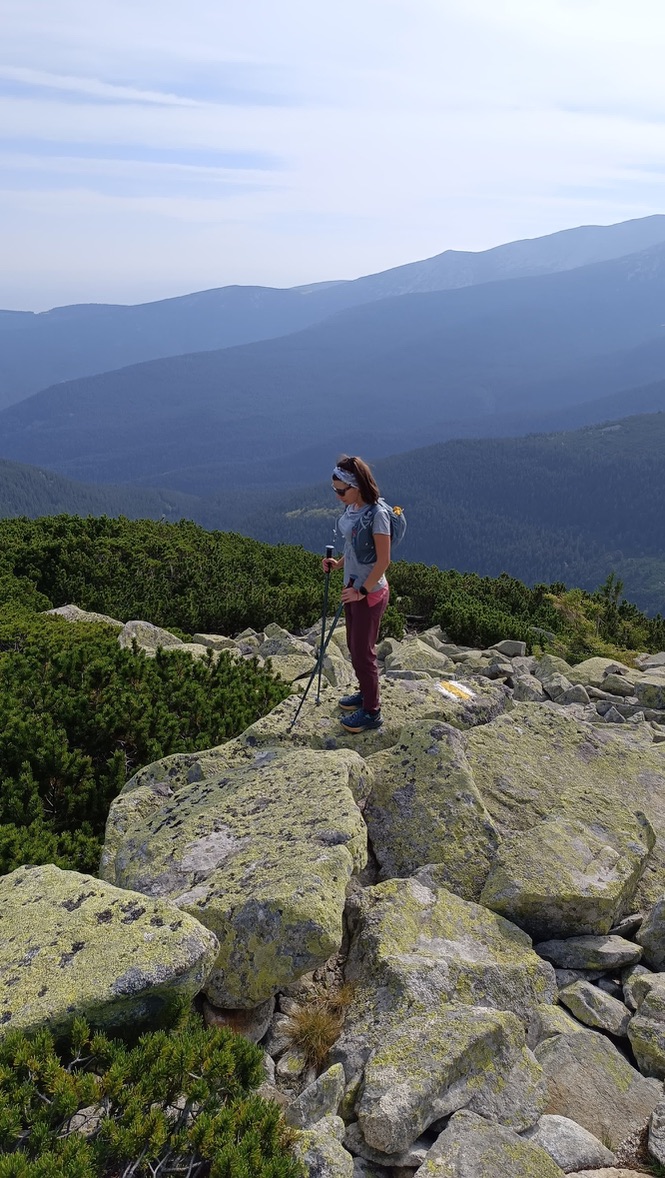
Somewhere above 2000 metres. The ridges go on forever. The 29km feels abstract from here.
Standing on the rocks at altitude, looking at the ridges stacked behind each other in every shade of blue, I had the thought I always have on mountains: this is worth every early alarm. The Retezat from the ridge looks like a painting of itself. Too much green below, too much sky above, the trail threading through lichen-covered boulders in a way that feels deliberate.
The dwarf mountain pine — jneapăn — grows in dense low mats between the rocks and catches your poles, grabs your ankles, redirects you constantly. You cannot move fast through it. Bears move through it fine, apparently. The mountain teaches you your pace whether you want to learn it or not.
The stop that wasn't optional
At some point in the middle of a long mountain day, your body starts negotiating. Not stopping — negotiating. It will keep going, it says, but something needs to happen first. Sit down. Eat something. Look at the flowers.
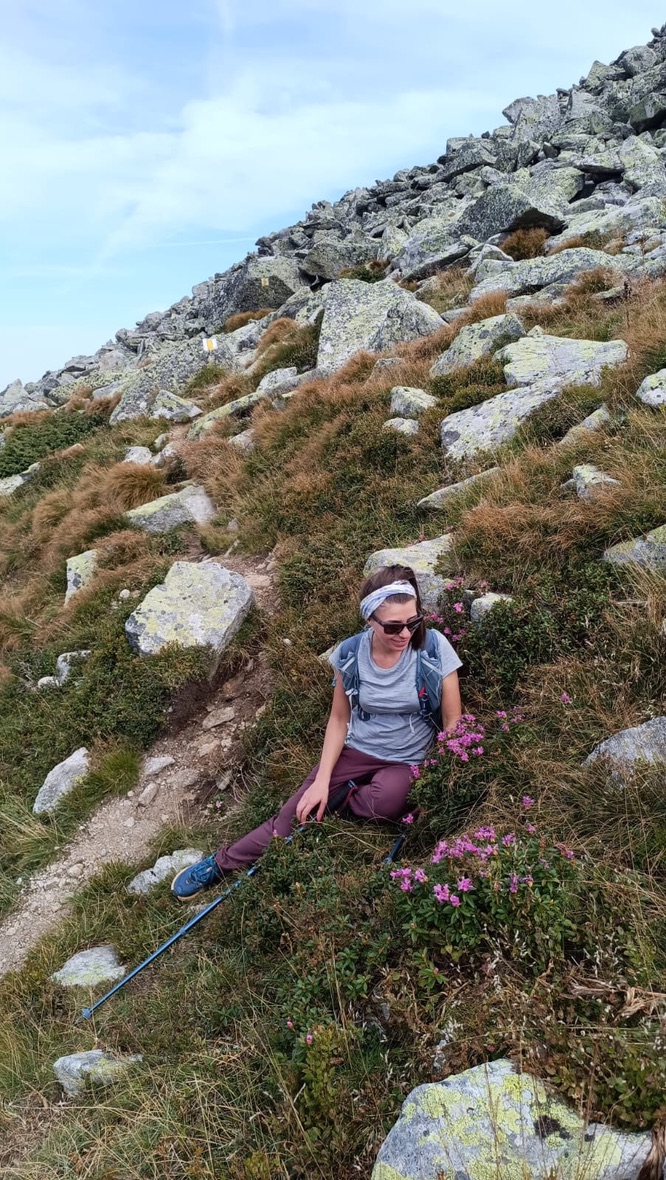
The rhododendron made me stop. The legs immediately agreed. Sometimes the mountain picks your rest spots.
The rhododendron in the Retezat blooms in summer in small fierce clusters — pink against grey rock, low to the ground, completely unbothered by the altitude. I sat down next to a patch of it officially to rest, unofficially because walking past it without acknowledging it seemed wrong.
Fifteen minutes on a slope, eating a bar, watching clouds move over the ridge. The legs stop complaining. The head goes quiet. This is the part nobody photographs and everyone needs — the middle pause, when you're too far in to go back and too far out to see the end, and the only thing to do is be exactly where you are.
The lake
The Retezat has over eighty glacial lakes. I believe it because I kept finding them — you come around a boulder or drop into a valley and there is another one, perfectly still, reflecting the peaks with the kind of accuracy that makes you stop and look twice.
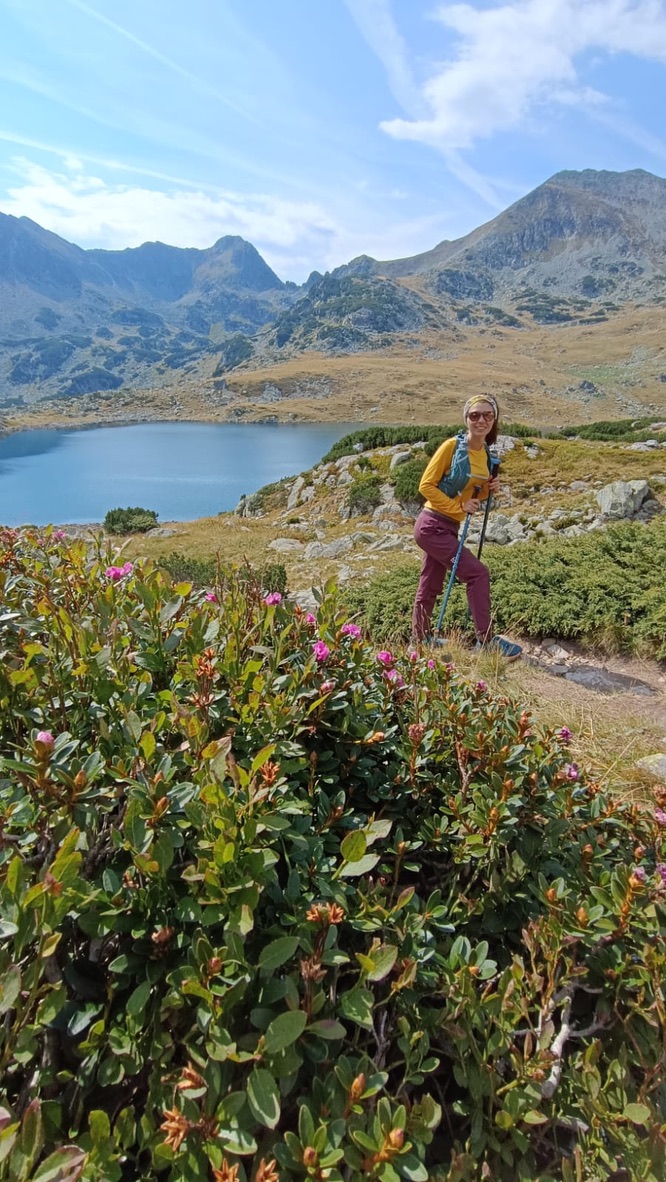
The lake that made the whole day worth it. The rhododendron was a bonus. The smile was involuntary.
Lake, flowers, peaks, light — a combination that produces an involuntary smile, which is the best kind. You don't decide to feel like that. It just happens when the place is at full capacity and your defences are down from hours of hard movement.
I ate lunch at the edge of the water. Sat longer than the remaining kilometres allowed. Did not regret it.
The boulder field
Seek discomfort. A motto I picked up and kept because it turned out to be true in practice. The boulder field at the end of a 29km mountain day is not comfortable. It is, however, interesting.
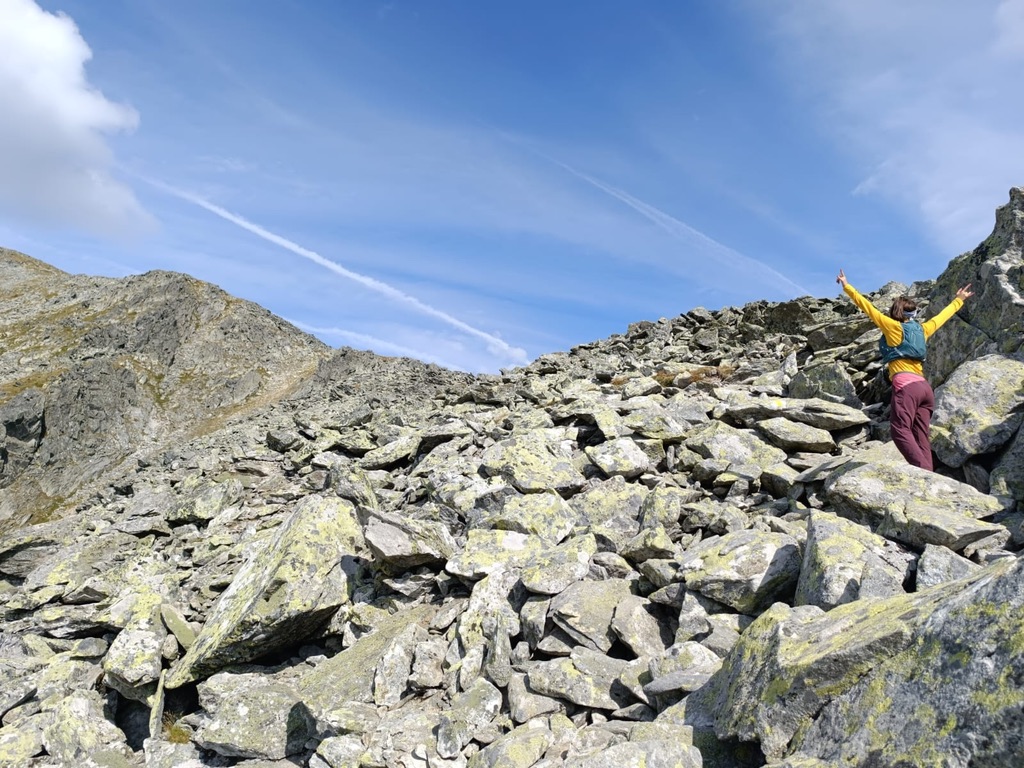
Seek discomfort. Always my motto. Arms up, legs done, completely worth it. Also: for scale, I am 1.60m tall.
A scree field requires a specific kind of attention. Every step is a small decision — weight placement, poles, eyes three steps ahead of your feet. At 1.60m you're closer to the ground than most, which helps with centre of gravity and absolutely does not help with reach. When you're tired, maintaining that focus is the thing that saves you from a twisted ankle.
I made it across. Arms up. Not because anyone was watching — nobody was watching — but because some moments need a physical response and arms raised at the top of a boulder field after 27km is the correct one.
What 29 kilometres in the Retezat actually costs
Your legs, for approximately two days. One blister on the right heel ignored for too long. One gel dropped somewhere on the ridge. The feeling, persistent for the last few kilometres, that you have made a mistake.
And on the other side: exactly 29km in your GPS data, permanently. The knowledge that your body, at 29, covered that ground in those mountains, with people who trained for this and wanted to be there. The particular satisfaction that comes from doing something hard on purpose — not because it was required, but because you decided it was worth finding out if you could.
You can. I want to do it again. I just want the right people to do it with — people who want to push, who want to live it fully. That's what matters more than the distance.
30km in the Retezat? Get insurance that covers it.
World Nomads offers simple and flexible travel insurance, with coverage for hiking, trail running and 150+ other activities. Buy at home or while travelling and claim online from anywhere in the world.
Get a Quote from World NomadsThis is an affiliate link — if you book through it, I may earn a small commission at no extra cost to you.